Tuesday, 9 August 2016

SUMMER SCIENCE SNIPPETS - COOL SHADES

THE SCIENCE BEHIND YOUR FAVOURITE SUNGLASSES

Whether you opt for heart shaped,the John Lennon look or wrap arounds you do need to protect your eyes from the sun.

The eyes are especially susceptible to the sun because of the transparency of the outer tissues. Long-term exposure can speed up ageing of the macula, the most sensitive part of the retina and can also lead to cataracts.

Look for sunglasses that meet the European safety standards. This means they will be of good optical quality with break-resistant lenses, providing high levels of protection against ultraviolet light, while not distorting colours. It's worth buying a pair with a dark tint and with plastic rather than glass lenses, for safety reasons. One of the key functions of sunglasses is to reduce the amount of sunlight entering the eye. Look for a pair offering a light reduction of up to 80%, that is they will allow in only 20% of the sunlight. The size of the lens - the area shielded - affects light admitted.

 Expensive sometimes means better, but not necessarily. What really counts is the degree to which the lenses filter out harmful UV rays. Look for the CE mark, which proves they conform to the European Community Standard. They should also satisfy British Standard BSEN1836, meaning they will provide high levels of protection against damaging ultraviolet light.

 Don't confuse the shade of the lenses with their ability to filter UV rays. Dark sunglasses may still allow UV rays to enter the eye. 
 Polarising lenses will reduce reflective glare from water and land surfaces, making them particularly good at improving vision in bright or hazy driving conditions.

What about if you wear glasses either for reading or everyday?
Photochromic lenses were invented in the USA  back in the 1960s but were very expensive when they first came to Britain and could be very slow to react.
The original lenses that darkened when exposed to UV rays were made from glass and although the technology has improved especially the speeding up of reaction time the science is still basically the same.
Glass photochrome lenses contain silver chloride crystals that when exposed to UV-A light ( 320 - 400nm) actually make dark elemental silver  & when in the shade the silver reverts to an ionic state and the lenses go clear.


Plastic lenses are different because they use photochromic dyes which rearrange in UV to give darker colours. The dyes need to be in specialist plastics and each company has its own proprietary polymer. Some even sandwich the dye between the plastic. It is an area of lucrative research with a huge market.
The next generation of transitional lenses hope to deal with the fact that drivers can't really use them because many car windscreens actually have a UV blocking coating effectively stopping the sunglasses working.

And in the future?.........
The very latest technology announced recently uses an electrochromic polymer changing colour with electricity


Chemical engineer student Chunye Xu and colleagues from Seattle have been working on "smart" sunglasses that can lighten or darken on command.
Using power from a watch battery the polymer can change shade in one second with milliwatts of power when the button on the side arm is pressed.
Electrochromic polymers are not new but this application uses such a small amount of power and is very quick to respond.
As a prototype they are rather heavy but have real possibilities. The team are also working on glasses to correct sight defects.


Saturday, 30 July 2016

A DAY AT THE BEACH - SUMMER SCIENCE SNIPPETS 2016


Summer is a lovely time of year.
Weather permitting we shed layers of clothing,spend time outdoors and maybe spend a day at the seaside,  wandering along the edge of the water, building sandcastles, skimming stones and exploring rock pools.
So this summer our blog  is all about the science of spending a day at the beach.


This week we explore the smell of the sea which is so evocative wherever you are on holiday and for many of us is that childhood memory.....
One of the first things you notice when you arrive is that amazing smell. There is nothing quite like the smell of the sea...... salty, clean, fresh, sandy.........
We often think the sea air is healthier for us and of course so bracing!


I don't want to burst your bubble but that distinctive smell has quite a bit to do with seaweed and decay......
It is a sulphurous smell produced seaweed begins to break down and die.........

It is actually hydrogen sulphide produced anaerobically which is toxic but not in the small quantities you find at the edge of the sea, plus  we also produce it as a natural part of our cycle :)

However you can also smell that amazing mix of salty water and sulphur tang when you are on a boat so it can't all be seaweed.

The oceans are full of minute phytoplankton and algae which contain and produce Dimethylsulphoniopropionate (!) DMSP used to regulate osmotic pressure in cells. 

This compound can be broken down by the cells and also by bacteria giving DMS and this has a very distinct smell - that we associate with oceans.
DMS is also involved in cloud formation - just under 10% makes its way to the atmosphere and into clouds.


So a day on the beach maybe wandering along the shoreline smelling the sea
 is really a chemistry lesson!!


Thursday, 21 July 2016

SUMMER SCIENCE SNIPPETS 2016 ARE COMING

So the holidays are here at last and following on from the success of last year we have created a set of new summer science blogs full of ideas for things to get up to over the holiday.
If you missed last year's great ideas look in the archive, check our featured post or follow these links

https://sueskimo.blogspot.co.uk/2015/06/summer-science-snippets-1.html

https://sueskimo.blogspot.co.uk/2015/06/summer-science-snippets-2_16.html

https://sueskimo.blogspot.co.uk/2015/06/summer-science-snippets-3.html

https://sueskimo.blogspot.co.uk/2015/07/summer-science-snippets-4.html

The first blog will be published next week so watch this space and follow on Facebook or Twitter for notification of new posts.

Have a great summer


BIG BANG NW 2016


WOW! WOW! WOW!
What an amazing day we all had at BBNW


This year we were in a new venue - The Exhibition Centre Liverpool which is right on the waterfront and a super space for a STEM event.
Being in one large hall made it easier for teachers to keep an eye on their pupils. It also gave the exhibitors a real buzz because they were with everyone else.
the show hall


In the centre was the show stage - a huge screen to make sure everyone had a close up view and plenty of seats. However the shows were a real draw so it was standing room only for every show all day. Thankfully there was room around the seating for people to gather and get a good view.
the show stage


The perimeter of the hall was where the large activities were - the accelerator, the pendolino train, the riding horse and milking cow.......you had to be there to see that!

Even larger exhibits were outside on the deck - Terry the Viking scientist and his team brought their longboat.
the Vikings


On Monday the set up started - by early afternoon the stage was almost finished and the stands were taking shape. As the evening wore on more and more companies, colleges and universities arrived to set up their stands.


We took all our kit taking advantage of the loading bay for easy access so that on the Tuesday morning we were able to park the car and walk through the main entrance.

We were on first so we set up our show tables in the early morning quiet and as everyone arrived we got our microphones on and after a quick sound check it was time to start.


We shared different bits from a variety of our shows - colour chemistry to start followed by disappearing hydrogel balls and introducing our huge blue polymer balls. We moved on to the freaky hand using bicarbonate and vinegar and then inflated a giant vet glove.


Helen made huge clouds of flame with milk powder


and then we set off a whoosh bottle.

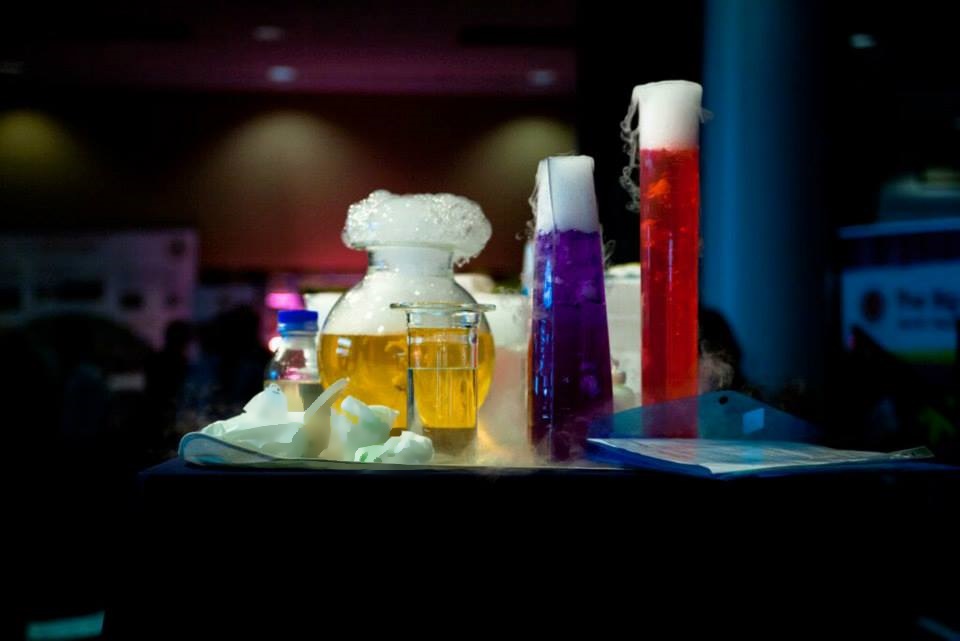
The finale was dry ice - what else!

Lots of clouds of fog, popping lids and a crystal ball bubble to finish.


It went well - even better in the afternoon session - people were sitting in the aisles to try to see.

The audience was very receptive - the other shows went really well too.
Tom Warrender shared his fascinatingly gruesome human guinea pig show - look away if you are squeamish time!!

Stefan Gates the Gastronaut showed us some amazing science based around food even blowing strawberry fragranced smoke rings at us all.

There are so many pictures from the day - Twitter feeds, Twitpics, Facebook pics and professional photos.
Putting BBNW or #BBNW should find some if you search and of course you can go to MerseySTEM and the dedicated Big Bang NW site for plenty of links to write ups, galleries and more.

If you didn't get this year I really would encourage you to sign up for 2017. This is the biggest FREE STEM event in our area and so worth doing. Don't miss it.

many thanks to everyone who shared their images of the day and for the professional images which are © MerseySTEM
Courtesy of Gareth Jones (Photographer)

SUMMER SCIENCE SNIPPETS 2

BUBBLES BUBBLES EVERYWHERE


When the weather is fine bubbles are fantastic. The science is amazing but to be honest they are just such good fun and even the adults join in

There are lots of commercial bubble makers in the shops.
How abut this machine that makes hundreds of small bubbles

or you can buy mixture and giant wands

but it is actually easy to make your own giant bubbles mixture and homemade wands and probably more fun too

Making bubble mixture is a bot of a dark art and you will find plenty of recipes of the internet especially Pinterest.
Many American sites talk about a washing up liquid called Dawn. It is just a clear standard liquid and any of our brands in the UK will work well. To be honest I have not found any difference between cheaper and more expensive brands apart from if using a concentrated liquid use less of it

Having run week long bubble workshops at Catalyst I have picked up a few tips:
  • don't be tempted to make the mix too strong
  • don't swish it around too much FOAM doesn't make bubbles
  • leave it to stand after making - overnight if possible
  • glycerine or light corn syrup like Karo give stable bubbles
  • a humid day is best or you can spray the air with water
A good ratio for your mix is 1 part washing up liquid: 5 or 6  parts water: 1/4 part glycerine

Home made giant wands are very simple and don't need much equipment.
Try this string and plastic straw version - give it a good soak in the mixture before using it


For bubbles you can stand inside use a hoop in a paddling pool


Everyone knows that bubbles are spheres....but have you see those frames that let you make a square or triangular bubble? OK you can't blow a square bubble - the laws of physics come into force. But it is quite interesting to see


For long tube bubbles you need a round frame which you can make yourself from wire or use an old frying pan splatter guard frame


Most of these techniques need a bit of work but bubbles snakes can be done by even the very youngest. Just remember to blow not suck

Follow the picture tutorial below using an old cotton or towelling sock or a flannel. 


this is what you get


This idea comes from Persil - some people who have scientists who study foam and bubbles so they probably know a thing or two

Someone else who knows all about bubbles especially giant ones is the science presenter Ian Russell. He often attends fetes and festivals where he creates these huge bubbles. You can find his website here:


Enjoy the sunshine and your bubbles


Monday, 6 June 2016

Show of the month for June

POTIONS

This month's Science Spot newsletter features our POTIONS show so I am sharing it with our blog readers
This show was created as part of one school's Harry Potter themed week and has become a favourite especially for end of term treats.
 With lots of dry ice in Hermione's cauldron and colour changing liquids to reactions that need to be woken up from a deep sleep.


 A set of rainbow coloured test tubes and disappearing gel balls. Eerie lights that appear like magic, amazing human light switches. Lots and lots of oozing slime….

Being true scientists we don't give away our secrets!  So many of our
demonstrations seem like magic so we began to collect amazing transformations, colour changes, disappearing materials and suddenly we really were in Hogwarts!

We invite potential wizards to join in an incredible experiment where they change clear liquid to bright pink and back again before our very eyes!

Dress up in your own costume or wear our wizarding hat to perform the experiment.


From bubbles to smoke to fire clouds this is an amazing show but of course we all know that even though some of the things seem
almost magic - it really is SCIENCE!!
Call us to find out how to book this show.
07972295527


Wednesday, 13 April 2016

SHOW of the MONTH - All About You

All About You

This month we are featuring a super show for Primary schools across both key stages. All About You looks at being healthy and how we can keep clean.
For the youngest pupils we bring along our third team
member Timmy the puppet who gets help from a friend in the audience to organise his lunchbox so that he can eat healthily. Great if you are part of the Healthy Schools scheme.   

We look at our amazing senses and how they help us, with brave volunteers choosing feely tubs or grot bags to put their hands into. 
Can you tell the difference between potato and apple if you can't see it or smell it??
Three super scientists get to use all their senses to try to identify the mystery liquid.


For slightly older ones we do a mass experiment to see how we are all unique. 
For the gross effect we discover just how much snot we produce, how much sweat we make and see the millions of skin cells shed every day. 

This leads nicely into why it is a good thing to actually wash. To help us keep our teeth clean we make our own toothpaste and test it against shop bought and finally Helen gives a  group of volunteers a gungy glitter cold to see why it is important to wash our hands.
Lots of valuable messages delivered in an interactive humorous way. The workshops complement the show—Super Senses for KS1 with feely bags, grot bags and mystery liquids. Toothpaste testing OR bath bombs for KS2.