Showing posts with label Communities First. Show all posts

Thursday, 12 October 2017

FUN at BRYNTEG CP week 3 - Electricity

This week we were sorting materials based on electrical conductivity.

We had taken some of our lights from our show Inside the Rainbow and as the room was darkened it looked a treat when the children arrived.


We looked in detail at the different lights especially the plasma ball and some of the class were able to light up fluorescent light bulbs using the energy from the ball.
We also explored some of our lights that work by "muscle power" our wind up torch and our Faraday torch. 
We then looked at how a complete circuit is needed to make the lights work by making our little ducks light up, our comsic ball and our energy sticks.


Then after everyone having a good experiment with the energy stocks we gave each table a tray of different materials so they could make circuits and test the materials to see if the conducted electricity or not.


The energy sticks light up and make quite a noise so this part of the session was quite lively!
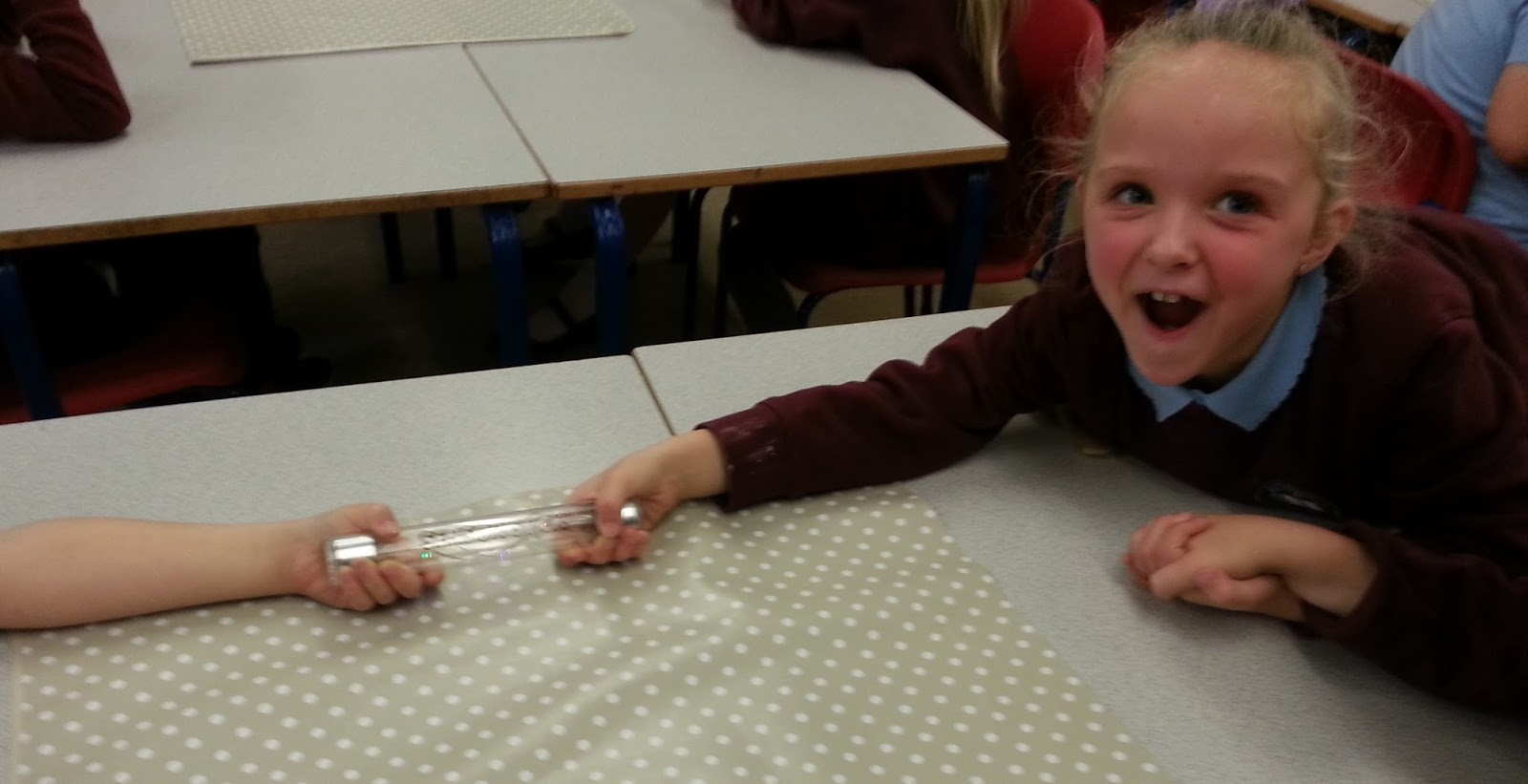
Finally we made a huge circle all holding hands and we saw that we could light up the energy stick using the  whole class.


Monday, 2 October 2017

FUN at BRYNTEG CP week 2 Colour Chaos

Our second week at Ysgol Brynteg near Wrexham

This week we worked with year 3 & 5 in the classroom exploring mixing and separating materials through colour.

First we thought about the impact that colour has on our lives. How food looks so unappetising when grey! How animals use colour for camouflage, enticement and warning.


After a short skill lesson in how to handle a pipette and create regular drops we used simple colour mixing to explore how from the three primary colours so many different colours can be made. Simple yes, but it is easy to forget that younger ones often don't actually know what happens if you mix colours. How lovely to hear an excited WOW! when blue and yellow made a stunning green.


Then we used ordinary felt pens to explore  splitting up colours using paper chromatography


We then used Sharpie permanent markers and alcohol in dropper bottles to split and spread the colour. Some of the colours didn't split but all of them spread in a very pleasant pattern


Finally we made a home made lava lamp using colour and light for effect


Next week we will be sorting materials depending on conductivity


Wednesday, 27 September 2017

FUN at BRYNTEG CP week 1


We have started another project with Reaching Wider Partnerships NW Wales and Communities First
This time we are in a small primary school just outside Wrexham - Brynteg CP.


After an initial visit last term to chat to the head and discuss arrangements we decided on a new format. This time our first visit was a full day with two shows on the morning and two workshops in the afternoon. We are trying to make the very best use of the finding available and this gives us a better cost on transport.

We arrived bright and early to begin to set up. The school's small breakfast club  were tucking into great looking breakfasts before watching a little episode of a film.

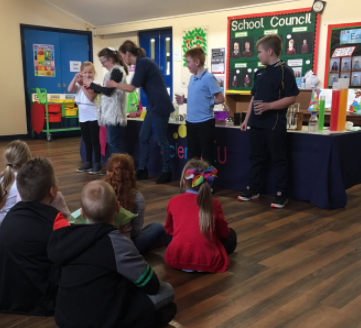
Once we were ready the first audience came in - KS1 - all excited and looking forward to some science. The school was in non-uniform and jeans to raise money on Jeans for Genes day which created quite a relaxed atmosphere.

The first experiment was to wake up a sleeping reaction....there were a few suggestions how we might do this....we discovered that shouting didn't work but giving it a good shake did. Amazement! A clear liquid turned either bright pink or blue with just a good shake and even more amazing as we watched it slowly turned back to being clear again!


That was easy and encouraged everyone to volunteer for the rest of the show. Lots of colour changes, lots of surprises and a dramatic dry ice finale!

After a quick reset during break time we were ready for the next show with KS2. These guys were just as amazed at the colour change science but wanted to know how it was all happening. They were also brilliant on their science vocabulary remembering the correct terms for what they were seeing happen before their very eyes.

As ever Helen's transforming mug got a round of applause but so did the Incredible Experiment - a demonstration of indicators and neutralisation which seemed almost magical.
The teachers joined in becoming human light switches by lighting up and putting out fluorescent light bulbs and we even had a go at blowing up one of the pupils.


Our dry ice finale with lots of pops and bangs went down a storm and then Mr Jones shared the good news - years 3 & 5 would be seeing us again because we were going into their classrooms in the afternoon to do some workshops.

A quick lunch and set up in the year 5 classroom for an afternoon of Pretty Amazing Polymers leading on from some of the demonstrations they had seen in our shows and getting up close to the kit!

scientists are making cups using maize
We investigated how slime is made and left some for the class to experiment with during the week.
Everyone had a good play with some thermo molding plastic and then they all got very up close to our hydrogel balls. Each table had a cup full and on the understanding that they cleared up their own mess they were able to test to destruction!
Finally after thinking about going to the toilet in space and what astronauts wear on the journey to and from the space station we experimented with the absorbency of disposable nappies.


Finally we left everyone with some homework - some hydrogel balls to hydrate during the week in as many different and unusual liquids as they could of.

Then it was time to do it all again with the second class.

The afternoon shot past so quickly and everyone really enjoyed being able to say " see you next week"



Saturday, 13 May 2017

Our Welsh Project Day 3

Off we went to Wales for the third day of our project.
This week we explored colour.
We thought about what it would be like if we lived in a black, white and grey world and how strange that would be.

With year 3 we first learnt a new skill - how to use a pipette to carefully get just one drop at a time where we wanted it to go - not an easy skill.

Then we experimented mixing primary colours to see what other colours we could make. We made a recording sheet to help with remembering what we had done and then began to explore lots of other colour combinations.
After mixing colours we looked at splitting colours up using chromatography.

First we used washable pens on filter paper with water which showed us that lots of colours are mixtures and will split into different and surprising colours as they spread along the paper.
Then we thought about the topic for the term which is China and how China has 5 primary colours - red, yellow, green, white and black. Each colour means something different, represents a different part of China and has good luck, happiness or other fortune connected with it.

Finally we used Sharpie pens to create a design on a small square of material tightly stretched over a beaker. We couldn't use water to spread these colours because Sharpies are permanent  so we carefully used a few drops of alcohol which made incredible rainbows. Everyone used their new pipette skills to drop the alcohol onto the material. It evaporated very quickly so the material was dry almost straight away. Well done year 3 on some great pipette skills!


Year 4 started by exploring chromatography using washable felt pens and water before brushing up on how to use a pipette. They then drew some super designs onto white material stretched over a beaker and dropped alcohol onto the centre to make stunning patterns as the colour spread.


We then looked at how nature uses colour to attract a mate, as camouflage so it doesn't get eaten or as a predator to hide so it can catch lunch or to warn because it is poisonous.


We looked in a bit more detail at the 3 primary colours we use compared to the Chinese 5 and how colours have special significance to Chinese people.
We also were bamboozled by some amazing optical illusions.


Finally we gathered round to watch a demonstration of a homemade lava lamp which we lit up using a small torch. I think there will be quite a few lava lamps happening at home this week!


Next week we will be looking at how scientists use  colour to tell whether a liquid is acid or alkali.