Showing posts with label primary science. Show all posts

Thursday, 24 January 2019

BRITISH SCIENCE WEEK 2019 ACTIVITY PACKS REVIEW - PRIMARY

Whether or not you are joining in with British Science Week in March you can still download and use their 2019 activity packs to add extra hands on in your classroom.

The theme for 2019 is Journeys and as the Channel Tunnel is celebrating 25 years of being operational there are science and engineering ideas using that theme in every pack.

At 37.9km (23.5miles), the Tunnel still holds the record for the world’s longest under-sea tunnel. The  project took five years to complete and involved over 13,000 engineers, technicians and workers. However, its journey started over 100 years before that; the first design for a cross-Channel tunnel was produced in 1802 and the first attempt at a tunnel excavation was in 1880. 
 The British Science Week activity packs feature activities relating to rock layering, tunnels and signals, and time and speed


In the primary pack there are quite a few very simple activities needing hardly any resources such as making a "snakes and ladders" type game but using tunnels as a theme or designing an infographic using the tunnel statistics as a focus.

There are also a few more unusual activities such as designing a lunar rover and I would build it too! 

I particularly like the Sneeze Zone experiment which shows how far droplets can travel when we sneeze. Use a water spray to demonstrate the difference between just sneezing, using your hand to cover your face and using a tissue.
This could also be linked to activities explaining why we need to wash our hands.


I also like the electric dough experiments from the popular science magazine Whiz Pop Bang. 
The idea is to make some very salty dough and using the science fact that salt is a great conductor of electricity use it to replace wires in an electric circuit. 

Pupils can use LEDs as eyes in a creature or make light up pieces of art or use LEDs as headlights.
This can be used to build on existing knowledge of circuits or as an interesting start to the topic. I think it would also make a finale to the topic because it is so different to conventional circuits. If there isn't enough information for you in the pack you can find much more about electric dough online


An Amazing Journey

A BRAND NEW SHOW for British Science Week 2019

The theme for this year is Journeys and we have created a super new show

The show An Amazing Journey goes ultra small—into the microscopic world that makes us healthy humans.  

In the show we meet RBC—the brand new red blood cell who is busy  learning how to deliver oxygen all around the body meeting other cells with important jobs like the superhero white blood cells who are busy fighting off diseases.  

We will be using our little friend the rhinovirus to show how germs spread, and measuring how far sneeze droplets can travel.


Our friend Cal ( calcium) will helps us discover how we need a healthy diet to give us strong teeth and bones and with audience help will build a skeleton .

We will also be finding out and decoding the secret messages deep inside  every cell making us totally unique.


This show for both Key Stages at Primary school has lots of dressing up and joining in and we are quite excited about it!! 

The class sized workshops to go with the show are KS1 Super Senses including feely tubs, smelly eggs and “the mystery liquid challenge” and for KS2 How Clean Are You? where we will be looking closely at gross and gruesome body bits plus making and testing toothpaste.


We want as many schools as possible to be able to book us for BSW so we are running a very special 50% discount for primary schools booking this show and workshops but as you know BSW is actually only one week so the offer is running during the whole of March. This means that  smaller schools could have us in for the whole day for as little as £250—an amazing price!   Email info@science2u.co.uk

If you are planning your own BSW event don’t forget to download the activity packs—there is one for each key stage. They are full of brilliant ideas—how about mummifying an
orange or making reflective clothing?
You can find them all here:


Thursday, 12 October 2017

FUN at BRYNTEG CP week 3 - Electricity

This week we were sorting materials based on electrical conductivity.

We had taken some of our lights from our show Inside the Rainbow and as the room was darkened it looked a treat when the children arrived.


We looked in detail at the different lights especially the plasma ball and some of the class were able to light up fluorescent light bulbs using the energy from the ball.
We also explored some of our lights that work by "muscle power" our wind up torch and our Faraday torch. 
We then looked at how a complete circuit is needed to make the lights work by making our little ducks light up, our comsic ball and our energy sticks.


Then after everyone having a good experiment with the energy stocks we gave each table a tray of different materials so they could make circuits and test the materials to see if the conducted electricity or not.


The energy sticks light up and make quite a noise so this part of the session was quite lively!
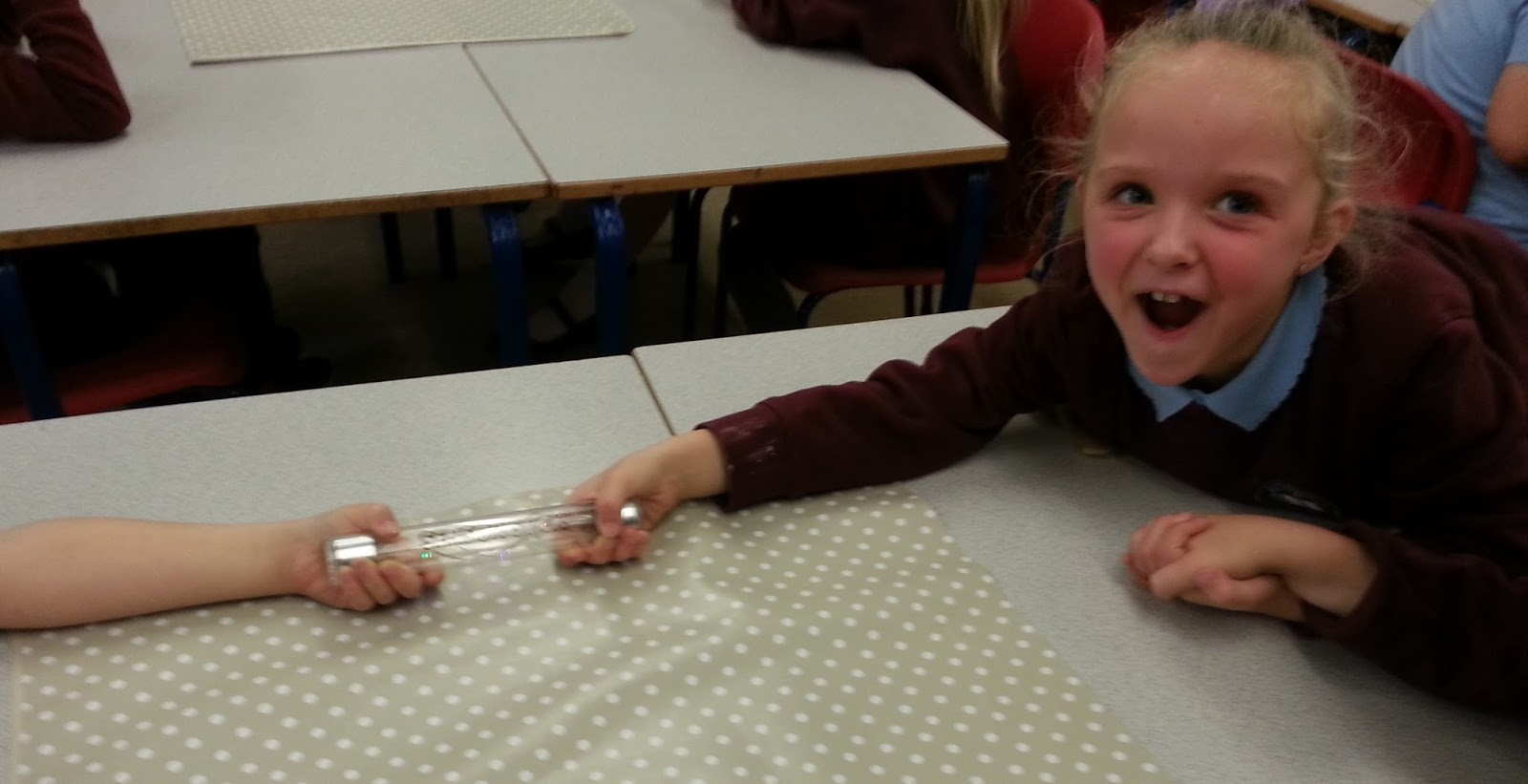
Finally we made a huge circle all holding hands and we saw that we could light up the energy stick using the  whole class.


Monday, 2 October 2017

FUN at BRYNTEG CP week 2 Colour Chaos

Our second week at Ysgol Brynteg near Wrexham

This week we worked with year 3 & 5 in the classroom exploring mixing and separating materials through colour.

First we thought about the impact that colour has on our lives. How food looks so unappetising when grey! How animals use colour for camouflage, enticement and warning.


After a short skill lesson in how to handle a pipette and create regular drops we used simple colour mixing to explore how from the three primary colours so many different colours can be made. Simple yes, but it is easy to forget that younger ones often don't actually know what happens if you mix colours. How lovely to hear an excited WOW! when blue and yellow made a stunning green.


Then we used ordinary felt pens to explore  splitting up colours using paper chromatography


We then used Sharpie permanent markers and alcohol in dropper bottles to split and spread the colour. Some of the colours didn't split but all of them spread in a very pleasant pattern


Finally we made a home made lava lamp using colour and light for effect


Next week we will be sorting materials depending on conductivity


Wednesday, 27 September 2017

FUN at BRYNTEG CP week 1


We have started another project with Reaching Wider Partnerships NW Wales and Communities First
This time we are in a small primary school just outside Wrexham - Brynteg CP.


After an initial visit last term to chat to the head and discuss arrangements we decided on a new format. This time our first visit was a full day with two shows on the morning and two workshops in the afternoon. We are trying to make the very best use of the finding available and this gives us a better cost on transport.

We arrived bright and early to begin to set up. The school's small breakfast club  were tucking into great looking breakfasts before watching a little episode of a film.

Once we were ready the first audience came in - KS1 - all excited and looking forward to some science. The school was in non-uniform and jeans to raise money on Jeans for Genes day which created quite a relaxed atmosphere.

The first experiment was to wake up a sleeping reaction....there were a few suggestions how we might do this....we discovered that shouting didn't work but giving it a good shake did. Amazement! A clear liquid turned either bright pink or blue with just a good shake and even more amazing as we watched it slowly turned back to being clear again!


That was easy and encouraged everyone to volunteer for the rest of the show. Lots of colour changes, lots of surprises and a dramatic dry ice finale!

After a quick reset during break time we were ready for the next show with KS2. These guys were just as amazed at the colour change science but wanted to know how it was all happening. They were also brilliant on their science vocabulary remembering the correct terms for what they were seeing happen before their very eyes.

As ever Helen's transforming mug got a round of applause but so did the Incredible Experiment - a demonstration of indicators and neutralisation which seemed almost magical.
The teachers joined in becoming human light switches by lighting up and putting out fluorescent light bulbs and we even had a go at blowing up one of the pupils.


Our dry ice finale with lots of pops and bangs went down a storm and then Mr Jones shared the good news - years 3 & 5 would be seeing us again because we were going into their classrooms in the afternoon to do some workshops.

A quick lunch and set up in the year 5 classroom for an afternoon of Pretty Amazing Polymers leading on from some of the demonstrations they had seen in our shows and getting up close to the kit!

scientists are making cups using maize
We investigated how slime is made and left some for the class to experiment with during the week.
Everyone had a good play with some thermo molding plastic and then they all got very up close to our hydrogel balls. Each table had a cup full and on the understanding that they cleared up their own mess they were able to test to destruction!
Finally after thinking about going to the toilet in space and what astronauts wear on the journey to and from the space station we experimented with the absorbency of disposable nappies.


Finally we left everyone with some homework - some hydrogel balls to hydrate during the week in as many different and unusual liquids as they could of.

Then it was time to do it all again with the second class.

The afternoon shot past so quickly and everyone really enjoyed being able to say " see you next week"


Saturday, 5 December 2015

Science club week 5

This week we were exploring pretty amazing polymers.
First we investigated a range of polymer shapes that absorbed water and grew.
We set up an experiment with spheres, nuggets and cubes covered with hot and cold water to see which began to grow quickest.
We then had a closer look at our amazing disappearing balls.

Is there anything in there? Whoah 100s of them!


Today's make was very exciting. We used a low temperature thermo moulding plastic which transforms from lots of little beads to a clear, stretchy piece which you can mould.
We have used thermoplastics before but this one transforms at about 45 degrees which meant it was ultra safe to use with younger pupils.
First everyone transformed their beads and had a good play noticing how long it took to go too hard to mould. With the low temperature it was lovely and warm to use but not too hot to handle or too sticky.


It was so easy to warm it and make it pliabletodan so after two or three goes we then added a key chain to our blob before pushing it into a mould full of glitter.
If it started to harden we just popped it into warm water again to soften it.

Then it needed to cool for about 10 minutes to go hard enough to pop out of the mould


Just before we all went home we set some homework!
Everyone got a cup with about half a teaspoon of dried hydrogel  balls. The instructions were to grow them in a liquid at home during the week. Any liquid-the more different types the better. Next week we will see which grew best and try to think why!

Thursday, 1 October 2015

New for the Autumn term

We have a new addition to our programme!
Pretty Amazing Polymers explores what it would be like to live in a world without polymers particularly plastic. Through a wide range of modern materials we look at how the disposable baby nappy absorbs liquid and what links a nappy to a roof tile!

We find out about other long chain molecules that can absorb liquid and where they are used including our disappearing hydrogel balls.

Have a look at this compilation of images to see how they grow. I've used coloured ones so that you can see!


We will see why plastic poses such a problem to our environment and see how  biodegradable polymers and recycling  are changing that.

We have created a complimentary workshop where we use a thermomoulding polymer to create a key ring to take home.


We are excited about both these sessions and hope they prove popular with schools.
We are aiming at upper KS2/lower KS3 to add to our Materials theme.

Wednesday, 3 June 2015

Brand New Workshop for KS1


We know that KS1 teachers love having us in to do shows and workshops but with the new 2014 science curriculum so many of the things we get up to have moved to KS2 so we decided to make sure the younger scientists didn't miss out by creating a workshop especially for KS1 to complement the show All About You.

Usually when we go to a school with our shows we have the whole school in a number of age appropriate groups but then if there is any time left we will work with class sized groups in workshops. Often this is KS2 so we have added a special workshop for KS1 to our programme.

Our show All About You is such good fun and full of amazing facts about our incredible bodies. When we are working with the younger ones we focus on things that really matter to them such as what can I have in my lunchbag if we are a Healthy Eating school? 


Timmy our 3rd member of the team comes along to helps the volunteers make a lunch bag full of healthy goodies that are good to eat. We have sourced some amazingly realistic prop food so we we pack up our insulated bag for lunch so that we can have some tasty snacks that keep us healthy.
We explore our super senses with feely tubs and grot bags....as you can guess the older ones love going for the grot bags and putting their hands into disgusting goo or slimy snot!!


We take our huge mouth and have a good explore of how to clean our teeth and what all those nashers actually do. Then we actually get a couple of volunteers out to make home made toothpaste and test it against shop bought.


We use our blue cuddly cold virus to talk about keeping healthy and safe from colds and to show how easy it is for colds and other nasties to spread we give a whole class a cold. Helen has the most amazing glittery snot you have ever seen!!


For KS2 we offer tasty toothpaste or bath bombs as a class workshop  and we have decided to extend part of the show about senses and make it into a full workshop for KS1. We have been busy sewing feely bags ( little bags which you put you hand into and try to decide what is inside just by feeling). Helen has sourced strange objects to put inside....nothing too scary but things which feel amazing. 

We have some lovely shakers as sound makers and have an ingenious way to let everybody test their sense of smell with some strange odours!!

Everyone who has tried this new workshop has really enjoyed it so now it has a full place on our programme alongside All About You our show about being healthy. Teachers can now choose to have a workshop with KS1 about Super Senses, with lower KS2 making toothpaste or upper KS2  making bath bombs.